
Financial Writing Portfolio:
Asset Management, Banking, and Private Markets.
Financial writing is read by people who know the subject, hold a position in it, and are professionally obliged to be skeptical: portfolio managers, allocators, analysts, compliance officers, and shareholders with long memories.
It has rules of its own:
Make the argument visible without the chart. State the number once and correctly. Never let style outrun substance. And, get to the point.
The work below was written for asset managers, banks, insurers, and private markets firms — including one of the world's largest asset managers, where regulated, investor-facing writing was the daily work.
Rather than a catalogue, we have chosen one piece in each of three formats: long-form research that carries an argument with evidence, short-form commentary that carries it to investors, and PR content that carries it to the public. Each is presented with its brief, an excerpt, and a link to the full piece. Additional samples in every format are available under NDA.
On this page:
Long-Form: Thought Leadership, Whitepapers, Research.
Short-Form: Articles, Commentaries, Newsletters.
Micro-Form: Social, PR, Advertising.
Long-Form:
Thought Leadership, Whitepapers, Research.
Long-form content, at its best, becomes a firm's north star: the statement of what it believes that every later decision, and every shorter piece of writing, is measured against.
It is the work that carries an argument with evidence — whitepapers, industry reports, macro outlooks, original research, and the internal memos and studies a firm writes for its own decisions.
Whether published to the world or circulated to a dozen people, the format is typically the same: a meticulously researched thesis, the support for it, and a conclusion the reader can act on or argue with.
Case Study: “The Emerging Real Asset Paradigm — Navigating an Inflationary Era”
Asset allocation whitepaper commissioned by a Fortune 500 financial services group and one of the largest retirement and asset management firms in the United States, written for advisors and institutional clients in the first inflationary environment in a generation. The paper identifies four structural reversals — deglobalization, demographics, decarbonization, and deficits — driving the shift from disinflation to inflation, tests the 60/40 portfolio against that shift, and makes the case for diversified real assets as the response.
The client is confidential. The sample shown is the manuscript as delivered rather than the designed edition the firm published.
Excerpt:
"The once-ubiquitous 60/40 investment strategy — the famous 60% equity and 40% bond allocation standard that has guided an untold number of portfolios — is displaying vulnerabilities in our rapidly shifting economic landscape. In 2022, the strategy reported its worst results in years, and among its worst in the last 40."
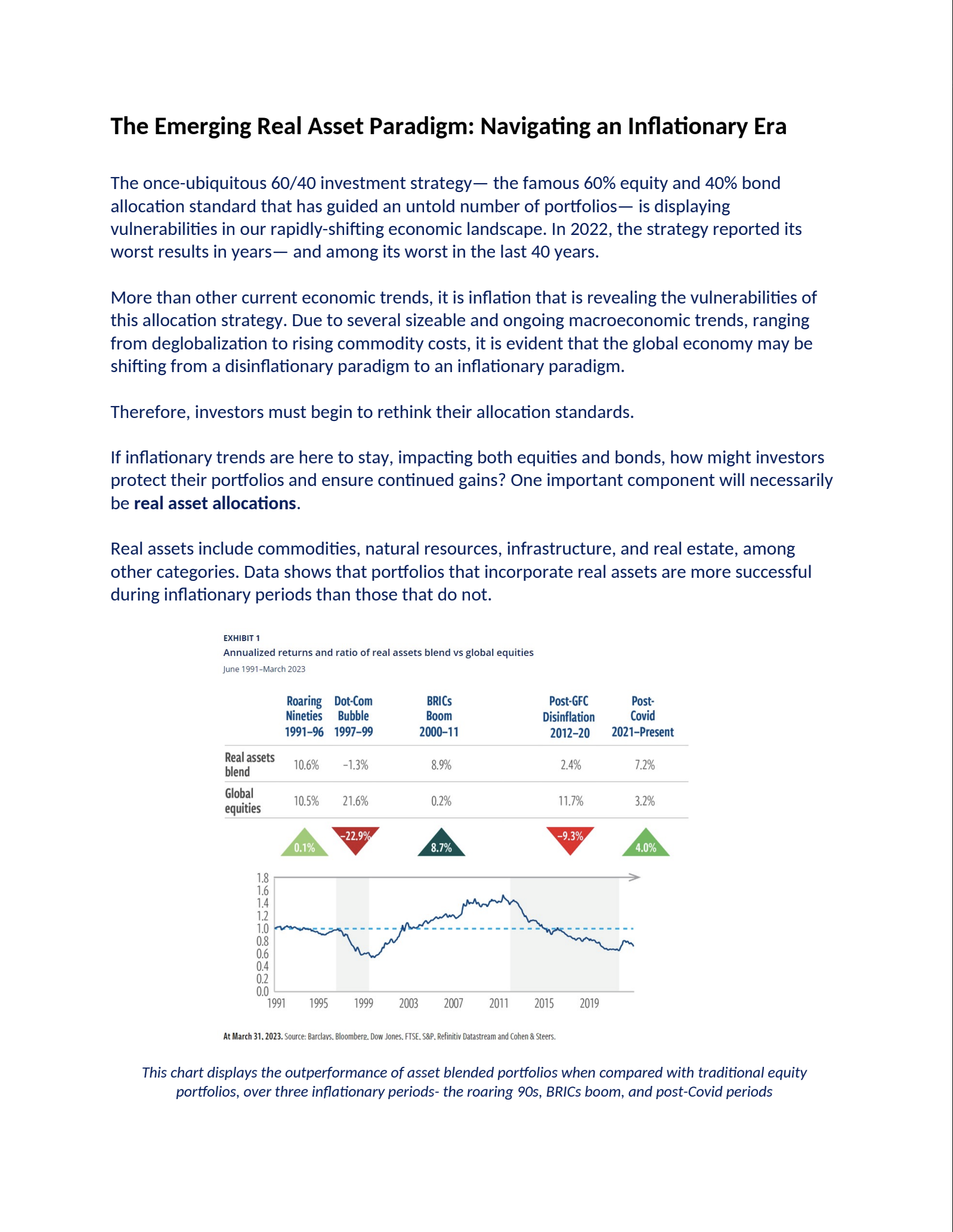
Whitepaper Manuscript.
Short-Form:
Articles, Commentaries, Newsletters.
Short-form content is how a firm stays in the conversation. Where long-form sets down what a firm believes, short-form applies it — to this quarter, this market move, this question from a client — and does so on a cadence a reader comes to expect.
It is the work that circulates: articles and op-eds for the press, posts for a firm's own site, fund commentaries and investor updates written to regulatory standard, and the newsletters that arrive in a client's inbox and are opened because the last one was worth reading.
The reader has minutes, not an afternoon, so the format is one idea, stated early and supported briefly, with a clear view of what it means for them. It is the writing that gets read most often, and the writing most likely to be forwarded.
Case Study: “Quarterly Fund Commentary — Small-Cap Equity Strategy”
Regulatory-facing fund commentary written for the investment management arm of a global custody bank, one of the world's largest. The engagement ran on a monthly cadence for more than a year, covering quarterly and monthly commentaries across several of the firm's equity strategies — each drafted to the firm's house standard, written to withstand SEC and FINRA review, and delivered against a fixed reporting calendar.
The sample is a quarterly review for a small-cap strategy: performance against benchmark, sector attribution, top contributors and detractors, portfolio activity, and the trailing twelve months. Nothing about it is designed to impress. That is the point. This is what the work looks like when it is done correctly, on time, every quarter.
The client is confidential. The strategy is not named and alterations have been made to protect confidentiality.
Excerpt:
"In Q2 2023, the Sample Strategy generated a return of 3.00% while the Russell 2000 benchmark index, an index of 2,000 small-cap companies, returned 3.47%. The Strategy underperformed the index by 47 basis points in the quarter. Stock selection contributed positively while allocation negatively impacted results."
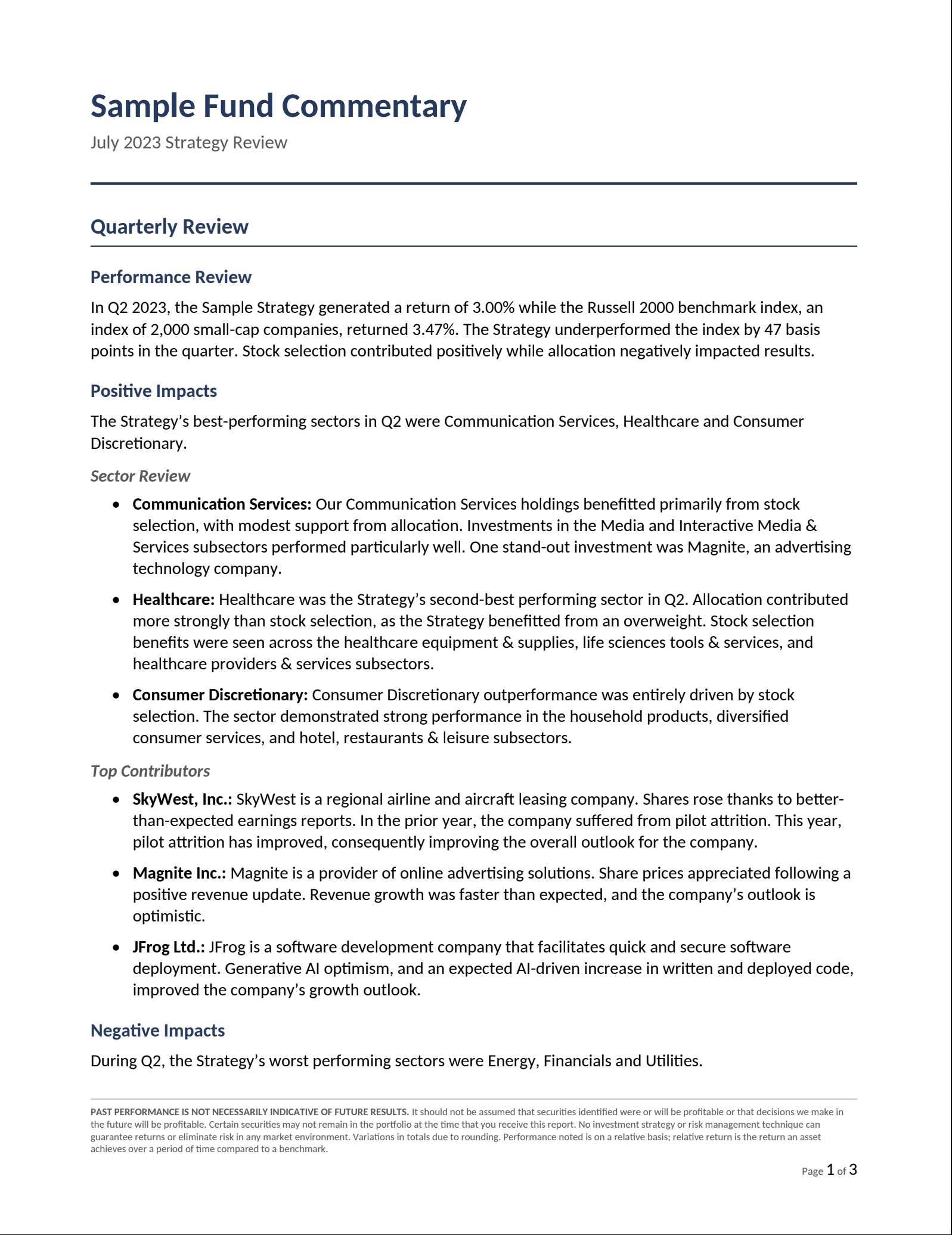
Quarterly Fund Commentary.
Micro-Form:
Social, PR, Advertising.
Micro-form content is where a firm's thinking meets the largest audience in the smallest space. A post, a headline, a quote in a press release, a line of ad copy — each is the smallest unit of a firm's voice, and the one the rest of the world is most likely to encounter.
It is the work built for the feed and the wire: social posts for executives and portfolio managers, press statements and media quotes, campaign and advertising copy, and the short lines that carry a long-form idea into a channel where no one will read the whole thing.
The format allows for no supporting argument, so the words must do the work alone: precise enough to survive a compliance review, distinctive enough to be recognized as the firm's, and clear enough to be understood in the time it takes to scroll past. It is the writing with the least room for error, and the widest reach.
Case Study: “Statement on U.S. Interest Rates” — for a Former Vice Chair of the Federal Reserve
Public statement on the outlook for U.S. interest rates, drafted for a former Vice Chair of the Federal Reserve through the editorial team of one of the world's largest asset managers. The principal's words move markets; the statement had to reflect his read on policy, inflation, equities, and bonds after Jackson Hole, in his register, at a length his audience would read in full.
Three versions were delivered — long, medium, and short — carrying the same substance at three lengths for different channels and readers. This is the discipline of micro-form in practice: the argument does not change, only how much of it the reader has time for. The editorial team selected and finalized the version that ran; the published wording was the client's.
The principal is not named. The sample shows the drafts as delivered, lightly edited for confidentiality and presentation.
Excerpt:
"After the latest Jackson Hole meeting, my read on U.S. rates is cautious on the macro, cautiously optimistic on bonds."
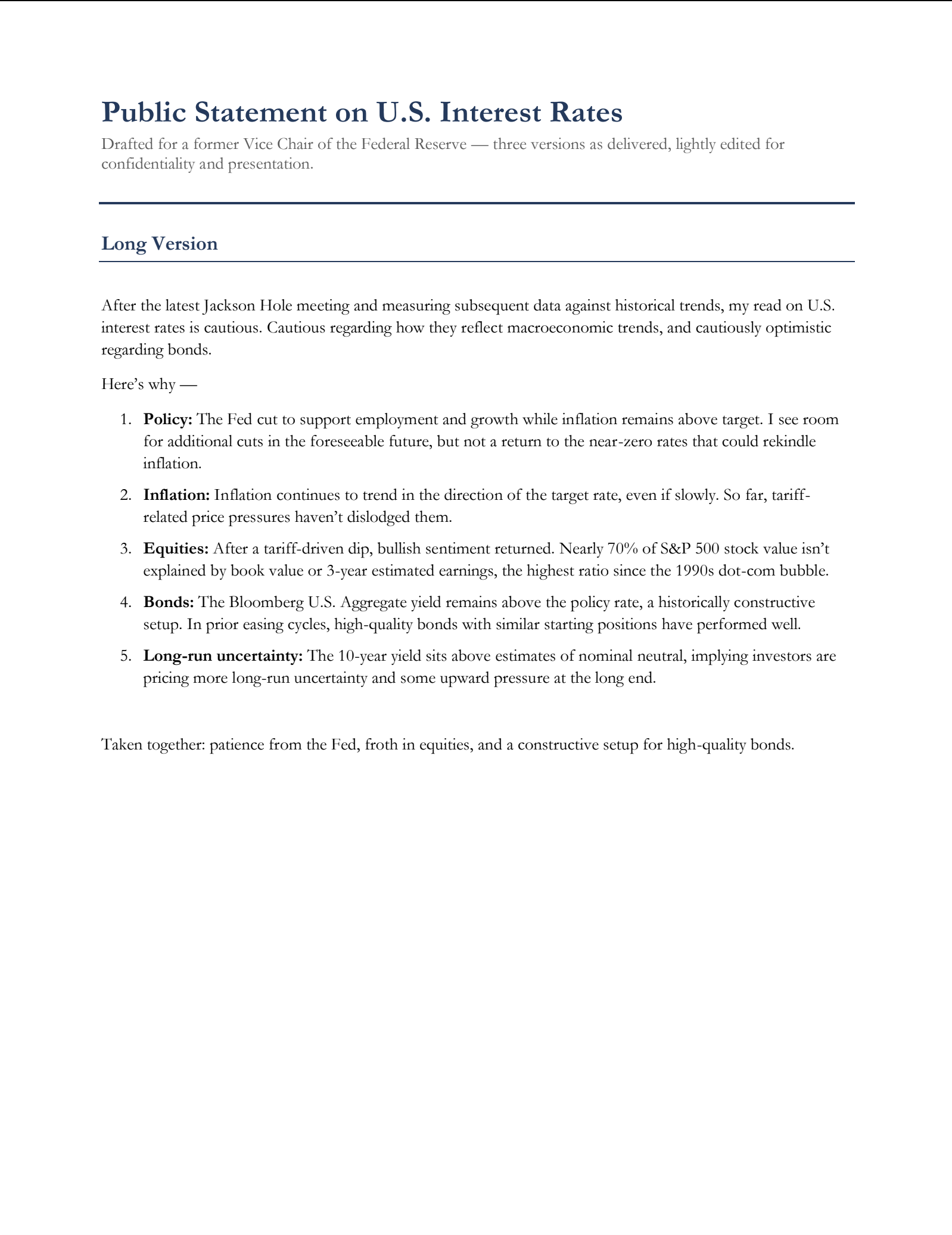
Public Statement.
About Robert Walker Cohen & Elegant Ink.
Elegant Ink was founded by Robert Walker Cohen, a Columbia University graduate whose career spans management consulting, venture capital, and financial communications at one of the world's largest asset managers.
His ghostwriting has included public statements for former Federal Reserve leadership, bylined articles for C-suite executives and founders from public companies to startups, and social content for portfolio managers and executive leadership at a global asset manager.
He handles every engagement personally. There is no bench.
Contact Us.
Interested in working together? Schedule a private consultation or fill out our contact form.
Based in New York City and serving clients across the Bay Area and international markets.