
Beyond Business:
Philosophy, Essays, and Fiction.
Everything else on this website was written for someone else. This page is the writing done under our own name: a philosophy thesis, a published essay, a book review, and three short stories.
Prospects rarely hire on this page. They read it to see whether the writer can think, and whether there is a voice underneath the ones he lends out.
Each piece is presented with its brief, an excerpt, and a link to the full piece.
Academic Writing:
The Thesis.
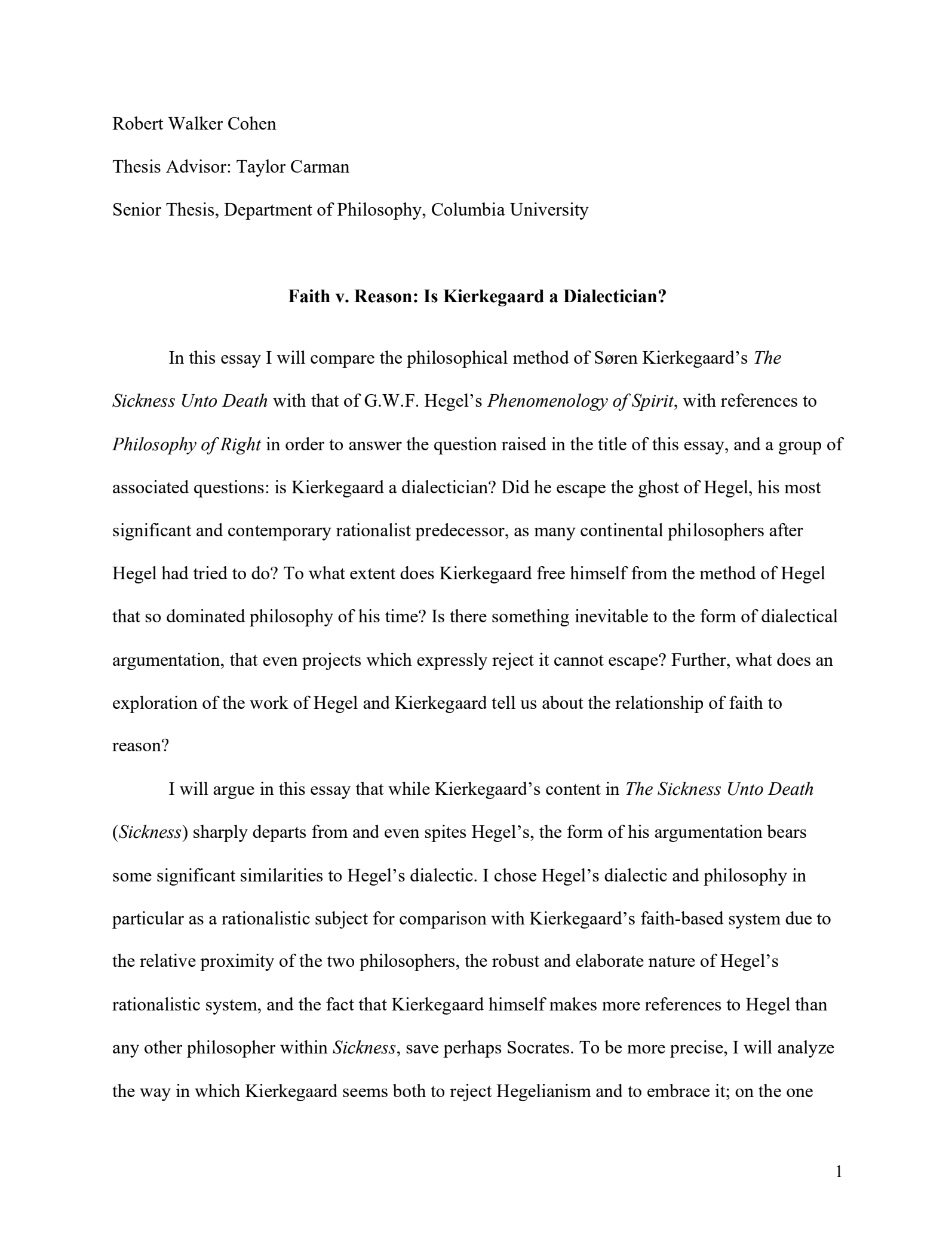
"Faith v. Reason: Is Kierkegaard a Dialectician?"
The Brief. Senior thesis in philosophy at Columbia University. The question was whether Kierkegaard, who spent The Sickness Unto Death mocking Hegel, nonetheless argued the way Hegel did.
The answer, over thirty pages, is a qualified yes: the form is dialectical, the content is not, and the "leap of faith" that resolves each stage is itself an act of refusing dialectic. Along the way the thesis proposes a term, "religious dialectic," for the structure Kierkegaard borrowed and then turned against its source.
The text is the thesis as submitted, lightly edited for presentation.
Excerpt:
"It is ironic, noteworthy, and typical of Kierkegaard that he, over the span of a page, both belittles the Hegelian project and claims to borrow from one of its core ideas. The dual nature of these successive claims might indeed be interpreted as dialectical, in that they embrace the utility of the method of Hegel's dialectical 'wonder game' as presented in the Phenomenology while simultaneously belittling it as no more than a game."
Columbia University Philosophy Thesis.
Published Essay:
Columbia University Philosophy Magazine.
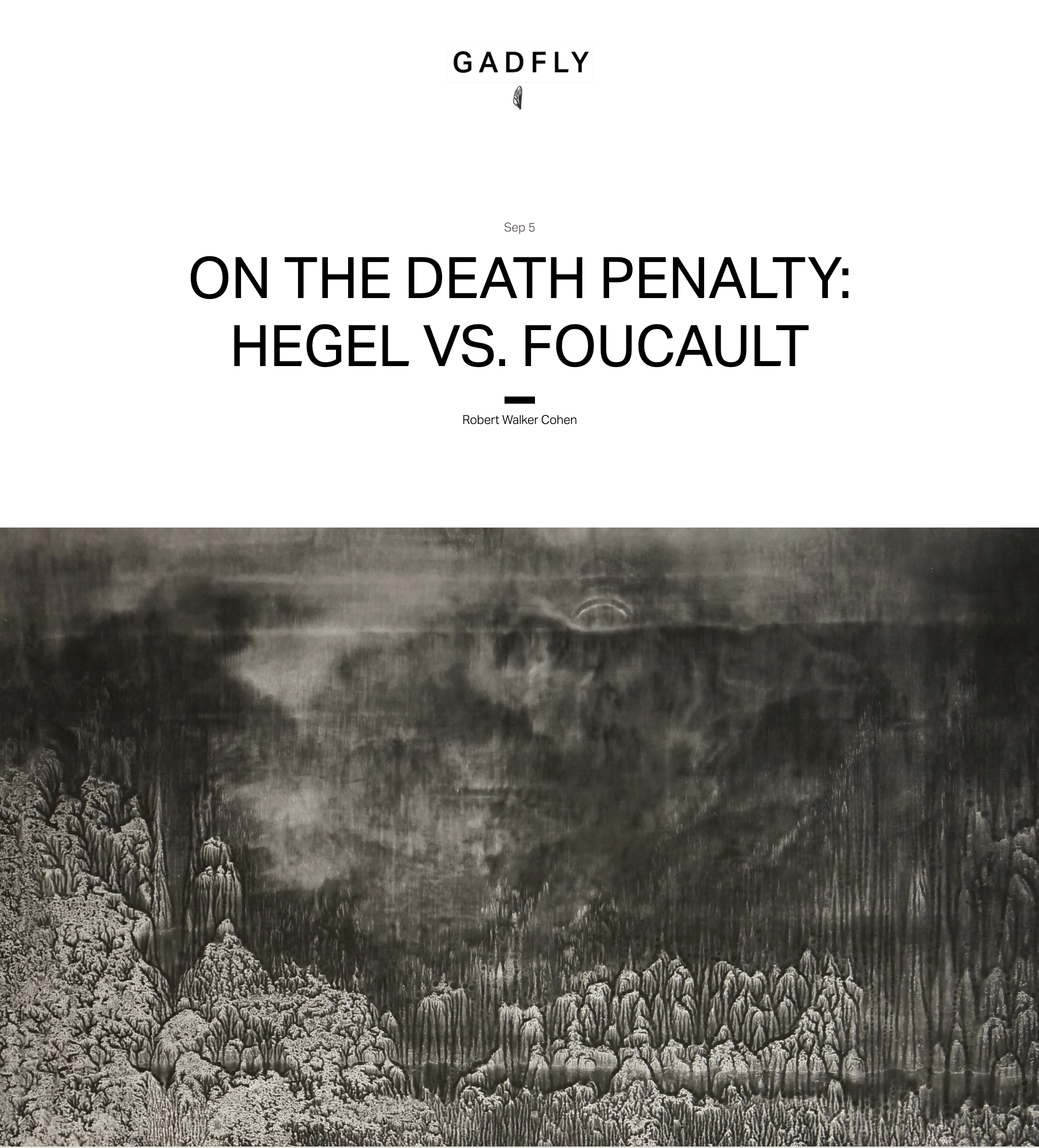
“On the Death Penalty: Hegel vs. Foucault”
The Brief. Published in Gadfly, the Columbia University philosophy magazine. The piece opens with the Rosenbergs' execution and asks why the Enlightenment's great champions of reason defended capital punishment while its post-modern critics, who trusted reason least, were its most persuasive opponents.
It reads Hegel's Philosophy of Right and Foucault's Discipline and Punish against each other and ends by arguing that Foucault's attack on Hegel may have made society more Hegelian than Hegel intended.
The text is shown as published, lightly edited for presentation.
Excerpt:
"Why would the greatest advocates for reason support the most unreasonable of punishments? Why might reason's critics argue for a more reasonable course of action?"
Personal Writing:
Review of The Creative Act by Rick Rubin.
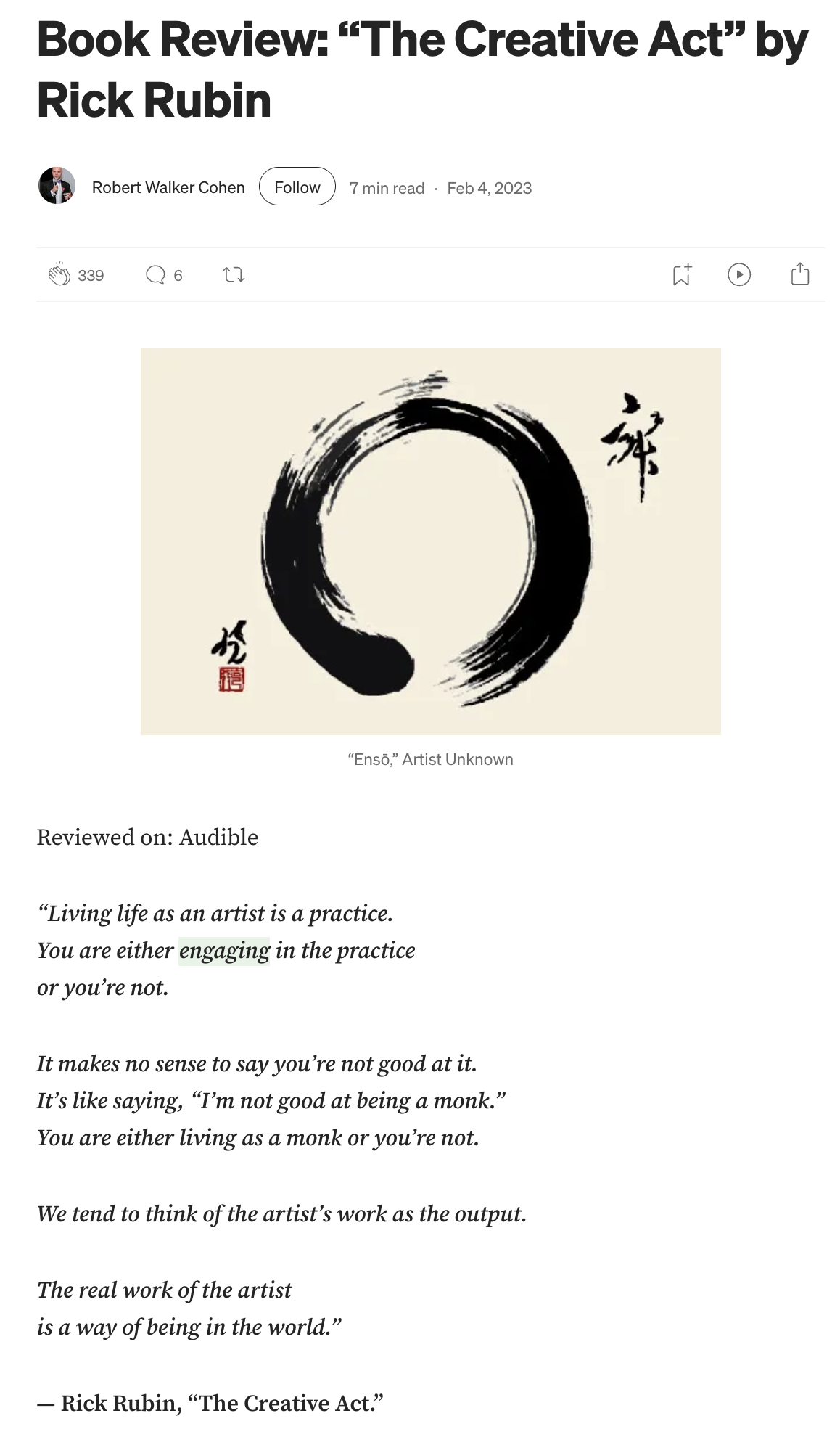
"Book Review: The Creative Act by Rick Rubin”
The Brief. A review of the music producer's book on creative practice, written after listening to the audiobook, for a personal blog. It sets out Rubin's central claim, that art is a way of being rather than an output, and sorts his advice into the warnings and the recommendations, with a view on which are more useful. The review closes with the review's own consequence: it was the piece that got the writer to stop waiting and publish.
The text is shown as published, lightly edited for presentation.
Excerpt:
"Rubin comes across as an earnest and dedicated park ranger, or perhaps a mystic resident, of humanity's wondrous park of art. He is eager to provide a tour of the artist's life, its implications, and its many tests."
Book Review.
Click here to read on Google Drive.
Originally published on Medium. Read it there.
Creative Writing:
Fiction.
"Three Stories”
The Brief. Three short stories in three registers, realist, comic, and fable: a man listening for his own pacemaker, a marching band that breaks ranks in front of the European Parliament, and a bee who breeds the sting out of her species. Written for a fiction workshop in 2021, with no commission, no client, and no reader in mind but the writer.
They have had only a light edit since, are rough in places, and would benefit from another pass. Shown as drafts.
Excerpt:
"That little machine that gives me life, it was ticking away. It was reminding me that my time is limited, and I better figure out which way I want to go. Some day that ticking will stop. Or at least, it'll carry on without me."
Short stories.
About Robert Walker Cohen & Elegant Ink.
Elegant Ink was founded by Robert Walker Cohen, a Columbia University graduate in philosophy whose career spans management consulting, venture capital, and financial communications at one of the world's largest asset managers.
Before he wrote for clients, he wrote for professors, magazines, workshops, and himself, and the habits he learned there, argument first, evidence second, voice throughout, are the ones his clients pay for.
He handles every engagement personally. There is no bench.
Contact Us.
Interested in working together? Schedule a private consultation or fill out our contact form.
Based in New York City and serving clients across the Bay Area and international markets.