
Technology Writing Portfolio:
Startups, Venture Capital, and Fintech.
Technology writing is read by people who build things and can tell when a writer has not: founders, engineers, investors, operators, and the reporters and recruits who decide whether a company is worth their attention. They read quickly, have heard every claim before, and reward clarity over hype.
It has rules of its own:
Know the product as well as the people who built it. Show the traction before the vision. Say what is new without calling it revolutionary. And, get to the point.
The work below was written for startups, venture capital firms, and fintech companies — including think pieces for a venture firm that were published in technology outlets and generated deal flow, and the first industry report on decentralized finance.
Rather than a catalogue, we have chosen one piece in each of three formats: long-form research that carries an argument with evidence, short-form commentary that carries it to the market, and the pitch decks and capital raise narratives that carry it into the room. Each is presented with its brief, an excerpt, and a link to the full piece. Additional samples in every format are available under NDA.
On this page:
Long-Form: Thought Leadership, Whitepapers, Research.
Short-Form: Articles, Newsletters, Media.
Venture Narratives: VC Research, Startup Pitch Decks.
Long-Form:
Thought Leadership, Whitepapers, Research.
Long-form content, at its best, becomes a company's north star: the statement of what it believes about where its market is going, which every product decision, and every shorter piece of writing, is measured against.
It is the work that carries an argument with evidence — industry reports, technical and market whitepapers, founder essays on the future of a category, original research, and the internal strategy memos a company writes before it commits.
Whether published to the world or circulated to a dozen people, the format is typically the same: a meticulously researched thesis, the support for it, and a conclusion the reader can act on or argue with. In technology, it is also the writing most likely to define a category before a competitor does.
Case Study: “The Platform Ecosystem Business Model — A Blueprint for Enterprises”
Industry research report for a publicly traded global technology consultancy, published as the first in a series on platform strategy for enterprise leaders. Robert served as editor in chief, taking research authored by the firm's PhD analysts and restructuring and rewriting it into a publishable argument — sharpened, sequenced, and raised to house standard without flattening the authors' point of view. The report defines the platform ecosystem model, explains why it outperforms on specialization and coordination, and sets out how an enterprise decides whether, and how, to become an orchestrator.
Published by the client under its own imprint; the edition shown is the one it released.
Excerpt:
“The Platform Ecosystem Business Model is a novel and disruptive business approach that has transformed global business.
Platform ecosystems are defined as open or closed networks where an orchestrator mediates relationships between a diverse set of complementary stakeholders. Orchestrators receive benefit from both accrued value in the platform ecosystem and in barriers to entry that ecosystems create for potential competitors. Platform ecosystems are also defined by a collaborative strategy that aims to create value for all stakeholders, including customers, partners, suppliers, and competitors.”

Industry Research Paper.
Short-Form:
Articles, Newsletters, Media.
Short-form content is how a company stays in the conversation. Where long-form sets down what a company believes, short-form applies it — to this launch, this funding round, this shift in the market — and does so on a cadence a reader comes to expect.
It is the work that circulates: op-eds and contributed articles for the trade and business press, posts for a company's own blog, founder and investor updates, promotional videos and media releases, product and market commentary, and the newsletters that are opened because the last one was worth reading.
The reader has minutes, not an afternoon, so the format is one idea, stated early and supported briefly, with a clear view of what it means for them. It is the writing that gets read most often, and the writing most likely to be shared.
Case Study: “Human-less Banking”
Bylined article on automation in retail banking, written for a partner at a publicly traded global consultancy and published on the firm's insights platform as the first of a two-part series on digital transformation in financial services. The brief was to make a banking audience take a provocation seriously: that every function of a bank, from lending to KYC to fraud monitoring, can be automated, and that the bank of the future is an app, not a branch. Written before conversational AI was in general use, it predicted chatbots would soon rival humans in customer service.
The principal is not named. The text is shown as published, lightly edited for presentation; the byline and page furniture have been removed. The second piece in the series is available on request.
Excerpt:
"Banking will be simultaneously depersonalized via the removal of human employees and personalized via the processing of vast pools of client data and interactions."
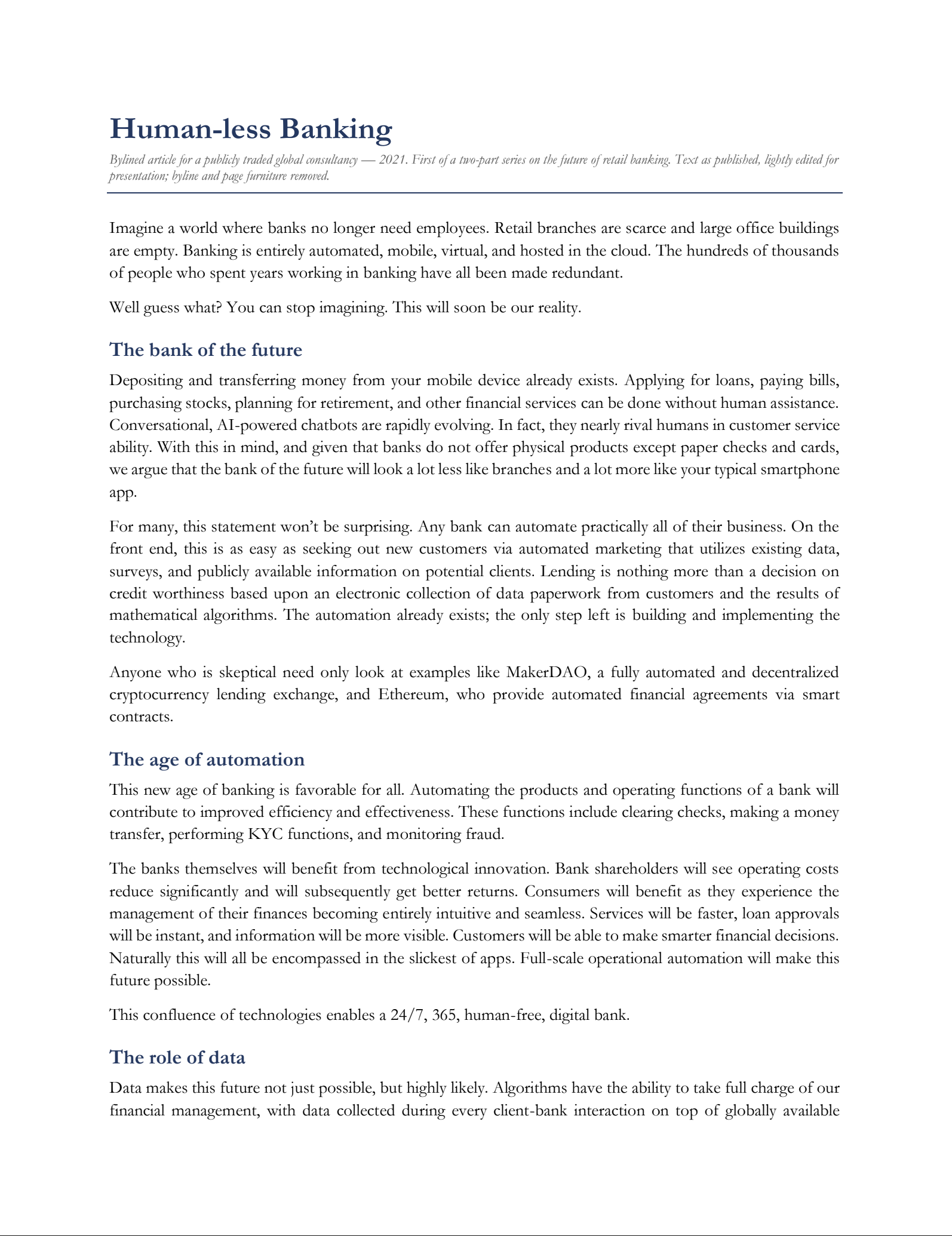
Digital Banking Article.
Venture Narratives:
VC Research, Startup Pitch Decks.
An investment is a story told twice — once by the company making its case, and once by the investor deciding whether to believe it. The pitch deck argues for capital; the research memo decides where it goes. Both are read by people who have seen a hundred like them that month and will decide in minutes whether to keep reading.
We have written on both sides of that table: decks and narrative memos for founders raising capital, and diligence reports, investment memos, and market research for the venture funds deciding where to deploy it. The work runs from thesis to ask, and from question to conclusion — the deck, the memo beneath it, the one-paragraph version a partner can repeat to committee without notes, and the research that determines whether the paragraph holds up.
The format has no room for a second chance, so every page must earn the next: the problem stated so the reader feels it, the traction shown before the vision, the ask made plainly — and, on the research side, the risks named before the upside. It is the writing with the highest stakes per word. Having written for the reader as well as the writer is the surest way to know what the reader will look for.
Case Study: “Due Diligence Report — Decentralized Governance Protocol”
Investment due diligence report prepared for a venture advisory firm on behalf of its client, an investor evaluating an early-stage blockchain governance protocol at the height of the token offering era. Fifty-six pages across team, technical, and business assessment — including a code review, token economics, SWOT, and competitive landscape analysis — structured to close the information gap between the investor and the company making the offer.
Robert wrote the report as an analyst on the deal team, including the preface on blockchain fundamentals published under his own byline. The contents page is shown; the assessment itself is not. Further detail available on request.
Excerpt:
"The intent of this report is to close the information asymmetry gap between our client and those who are offering the investment opportunity. We will look at the company on offer from the lens of people (the talent and track record on the founding team), product (a review of their code and user experience), and competitive landscape (the attractiveness of this opportunity in the broader world of blockchain ICOs)."
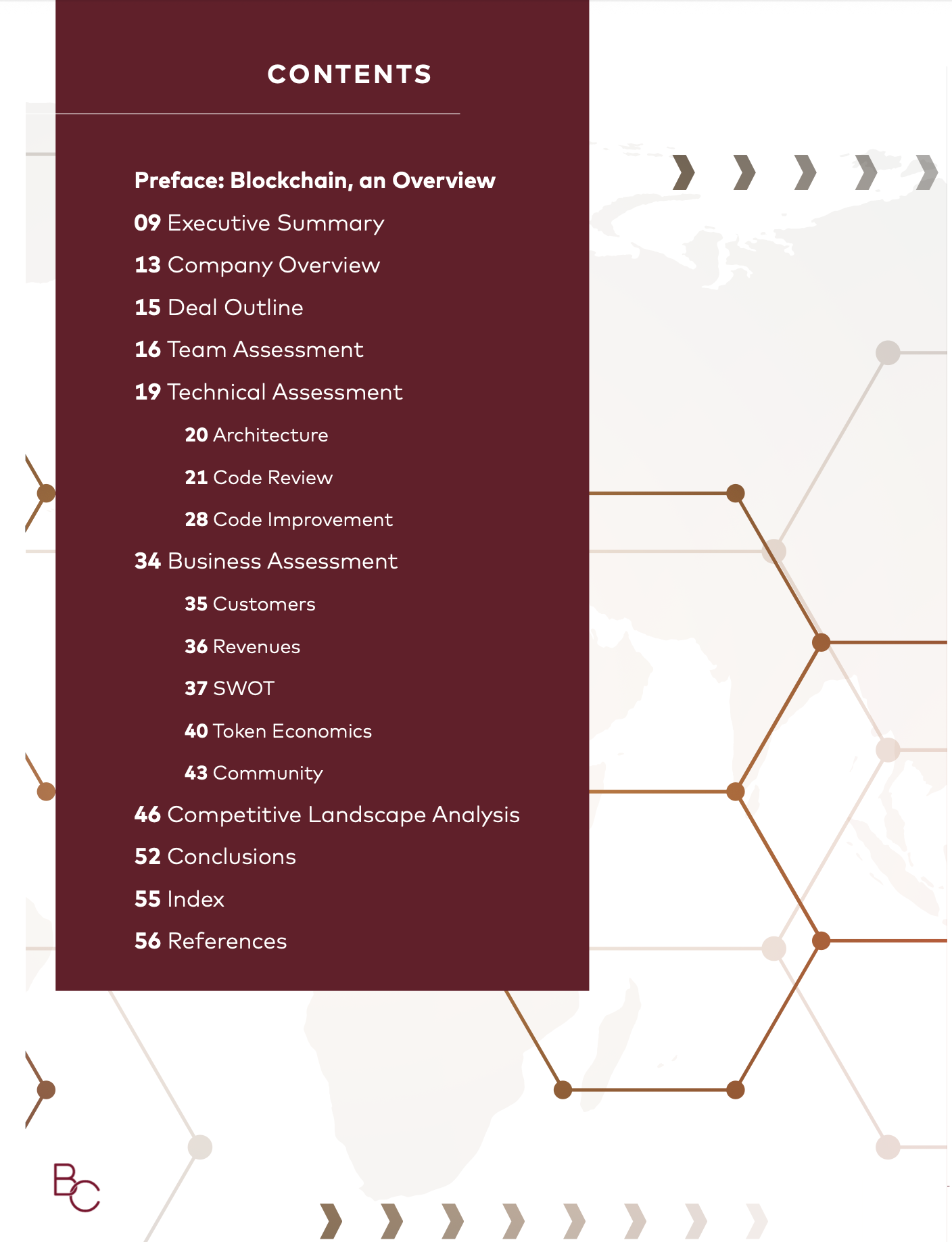
Due Diligence Report.
Further detail available on request.
About Robert Walker Cohen & Elegant Ink.
Elegant Ink was founded by Robert Walker Cohen, a Columbia University graduate whose career spans management consulting, venture capital, and financial communications at one of the world's largest asset managers.
His ghostwriting has included public statements for former Federal Reserve leadership, bylined articles for C-suite executives and founders from public companies to startups, and social content for portfolio managers and executive leadership at a global asset manager.
He handles every engagement personally. There is no bench.
Contact Us.
Interested in working together? Schedule a private consultation or fill out our contact form.
Based in New York City and serving clients across the Bay Area and international markets.